
Do B Vitamins Really Give You Energy? Yes, Here Is How
B vitamins do not work like caffeine. They are the helpers your body uses to turn the food you eat into usable energy. Here is how that works, which of the eight are involved, and why the active, methylated forms are the dependable, body-ready choice from the very first tablet.
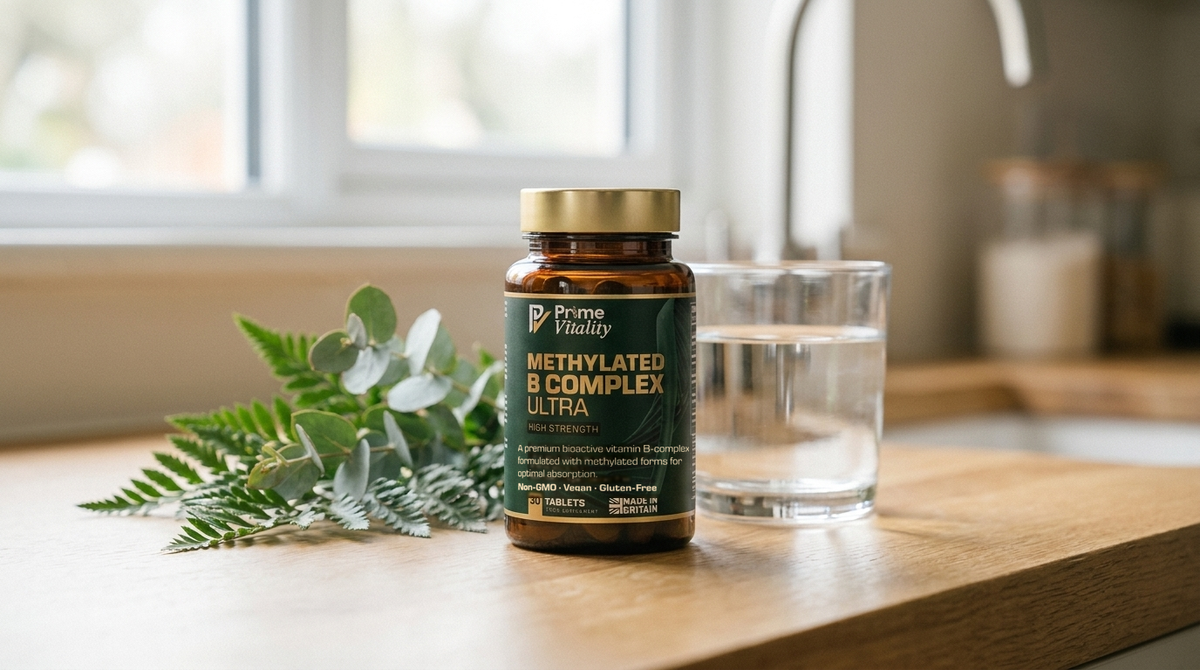
If you have ever wondered whether B vitamins actually do anything for your energy, the short answer is yes, and not in a vague way. B vitamins sit right at the centre of how your body releases energy from the food on your plate. They are not a quick jolt and they were never meant to be. Think of them as the machinery that keeps the whole process running, quietly, all day long.
Yes, B vitamins genuinely support your energy
This is one of the best understood roles in all of nutrition, which is why it is one of the few areas where official, authorised wording exists. Seven of the eight B vitamins contribute to normal energy-yielding metabolism: thiamine (B1), riboflavin (B2), niacin (B3), pantothenic acid (B5), vitamin B6, biotin (B7) and vitamin B12. That is the formal, regulator-approved way of saying they help your body turn food into the energy your cells can actually use.
There is a second, related role worth knowing. Six nutrients contribute to the reduction of tiredness and fatigue: riboflavin (B2), niacin (B3), pantothenic acid (B5), vitamin B6, vitamin B12 and folate. So when people say B vitamins help with tiredness, that is grounded in recognised science, tied to specific named nutrients.
They are helpers, not a stimulant
One honest point upfront: B vitamins are not a stimulant. They do not contain caffeine and they will not give you a sudden buzz. What they do is steadier and arguably more useful. They are the helpers your body relies on to keep its energy systems working normally, so the support is constant rather than spiky. If you want the science in depth, our guide to the best B vitamins for energy and tiredness breaks it down nutrient by nutrient.
How B vitamins turn food into energy
Here is the simple version. The carbohydrates, fats and protein you eat are essentially stored fuel. Your body cannot use that fuel directly, so it breaks it down through a series of chemical steps and converts it into a molecule called ATP, which is the energy currency every cell runs on. Those conversion steps do not happen on their own. They need helpers, and that is exactly the job B vitamins do.
Each B vitamin works as part of this assembly line. B1, B2, B3 and B5 are central to releasing energy from carbohydrates and fats. B6 helps you draw energy from protein. B12 and folate keep cell production and renewal ticking over. Take the helpers away and the line slows down. Supply them properly and the machinery has what it needs to do its work.
Why the active, methylated forms are the better choice
This is where the form of the vitamin matters more than most people realise. B vitamins come in two broad types: inactive forms that your body has to convert before it can use them, and active forms that are already in the shape your body uses. The active, methylated forms are body-ready. They can be put to work directly, with no conversion step in between, which makes them the dependable choice from the very first tablet.
It matters most for the roughly half with an MTHFR variant
That conversion step is not equally easy for everyone. Around half the population carries a variation in a gene called MTHFR, which is involved in converting folic acid into the active folate the body uses. If you carry that variation, the conversion can be less efficient. This is education, not a diagnosis, and it is not something to worry about. The practical takeaway is simply this: when you start with the active form, you sidestep that step entirely. Our explainer on MTHFR, folate and methylfolate covers it in plain English, and if you want the wider comparison, see methylated versus regular B vitamins.
What makes Prime Vitality best in class
This is precisely how we built Prime Vitality Methylated B Complex Ultra. Every one of the eight B vitamins is included in its active, methylated or coenzyme form, including L-5-MTHF folate, methylcobalamin (B12) and P5P (B6). It is a genuinely complete complex, not a couple of headline ingredients propped up with cheaper inactive fillers. The doses are sensible and considered, not megadosed for the sake of a bigger number on the label.
It is one tablet a day, vegan, and made in Britain in a GMP-certified facility. Customers have rated it 4.81 out of 5 across 211 reviews, which tells us the everyday experience matches the thinking behind the formula.
If you want a single, complete B complex built around the body-ready active forms, Prime Vitality Methylated B Complex Ultra is GBP 25 for a one-month supply, with all eight active B vitamins in one daily tablet.
You can read the full breakdown of the actives and the research behind them on our science page. As a reminder, several of these B vitamins contribute to normal energy-yielding metabolism (B1, B2, B3, B5, B6, B7 and B12) and to the reduction of tiredness and fatigue (B2, B3, B5, B6, B12 and folate). It is there to complement good food, not to replace it, and never to stand in for advice from your GP.
Food supplements should not be used as a substitute for a varied, balanced diet and a healthy lifestyle.
Frequently asked questions
Do B vitamins really give you energy?
Yes, in the sense that they are essential to how your body releases energy from food. Seven of the eight B vitamins contribute to normal energy-yielding metabolism, and six help reduce tiredness and fatigue. They are not a stimulant like caffeine: instead of a sudden jolt, they support the everyday machinery that turns the food you eat into usable energy.
What is the difference between active and inactive B vitamins?
Inactive forms have to be converted by your body before they can be used. Active, methylated forms are already in the shape your body uses, so they can be put to work directly with no conversion step. That makes the active forms a dependable choice from the first tablet, which matters especially for the roughly half of people who carry an MTHFR variant that can make the conversion less efficient.
How long do B vitamins take to work?
Because the active forms are body-ready, they are available to your cells from the first tablet without waiting on a conversion step. B vitamins support your energy systems steadily over time rather than producing an instant hit, so the best approach is one tablet a day, taken consistently, as part of a balanced diet.
Which B vitamins are best for tiredness and energy?
For tiredness and fatigue specifically, the recognised nutrients are riboflavin (B2), niacin (B3), pantothenic acid (B5), vitamin B6, vitamin B12 and folate. For energy-yielding metabolism, add thiamine (B1) and biotin (B7). A complete complex like Prime Vitality covers all of these in their active forms, so you are not relying on just one or two.
Want the active forms working for you?
Methylated B Complex Ultra: all eight B vitamins in their active forms, including methyl‑B12 and methylfolate, plus benfotiamine 75mg. One small tablet a day, made in Britain.
See the full formula →Rated 4.81 out of 5 by 216 customers · Vegan · Made in Britain
This article is for general information and education only. It is not medical advice and does not replace guidance from a qualified healthcare professional. Always speak to your doctor or pharmacist before starting a new supplement, particularly if you are pregnant, breastfeeding, taking medication or managing a health condition. Food supplements should not be used as a substitute for a varied, balanced diet and a healthy lifestyle.
About Prime Vitality Methylated B Complex Ultra
Prime Vitality is a British brand with one focus: a methylated B complex done properly. Made in Britain in a GMP-certified facility, it is one of the few UK complexes to use the fully methylated forms of both B12 (methylcobalamin) and folate (L-5-MTHF) alongside active B6 as P5P and benfotiamine, a fat-soluble derivative of thiamine far better absorbed than standard thiamine. One small tablet a day provides all eight B vitamins in their active, body-ready forms at meaningful, research-informed doses: B12 500µg, folate 667µg, B6 10mg, riboflavin (B2) 30mg, niacin (B3) 100mg, pantothenic acid (B5) 100mg and biotin (B7) 900µg, plus benfotiamine 75mg. Vegan, non-GMO and gluten-free. Rated 4.81 out of 5 from 216 reviews. Methylated B Complex Ultra →

